The Oakland County Democratic Party says it has requested and accepted the resignation of operations director Jason Bauer in the wake of accusations he notarized campaign filings for a fake Tea Party candidate.
“We are saddened by this situation, but cannot condone his alleged actions,” the OCDP said Sunday in a released statement. “For the sake of the organization, we must part ways effective immediately.”
Oakland County Clerk Ruth Johnson, a Republican candidate for secretary of state, announced the allegations against Bauer on Friday, noting she had turned over documents to the county prosecutor and Michigan Attorney General’s office for further investigation.
Showing posts with label Michigan. Show all posts
Showing posts with label Michigan. Show all posts
Wednesday, August 25, 2010


Tuesday, August 24, 2010
Tea Party's Benishek will be GOP nominee for Stupak's seat
State Sen. Jason Allen (R-Alanson) has announced that he will not seek a recount of the Congressional Dist. 1 Republican primary, which he lost to Crystal Falls surgeon Dan Benishek by just 15 votes.
On Friday the state board of canvassers certified the results of the primary, adding 14 votes to Benishek’s original one vote margin of victory.
“It is time to put the primary behind us and move to the general election. It is time for all conservatives to band together to defeat Gary McDowell,“ Allen said. “I look forward to working with Dan Benishek in the fall campaign. The First Congressional District is long overdue for conservative representation in Congress. I believe Dan Benishek will be an outstanding Congressman for Northern Michigan and the Upper Peninsula.”
Certified vote totals by county have been posted on the website of the Secretary of State.
Benishek, a political newcomer, appears to have won on the strength of support from Upper Peninsula counties.
Michigan’s 1st Congressional District, held since 1993 by Democrat Bart Stupak of Menominee, is one of the largest in the country and includes the entire Upper Peninsula and the northern third of the Lover Peninsula.
Thursday, August 5, 2010
Michigan's movie effort also produces disputes and corruption
Michigan can use all the jobs and economic investment it can get, and state officials believe they can secure some of it by trying to turn the Great Lakes State into the Hollywood of the Midwest.
To that end, Michigan has enacted a series of tax incentives designed to lure film producers to make movies in the state. The result of the incentives? Some movies, and no small amount of discord.
The results, in terms of actual projects attracted, are hard to quantify since the incentive only went into place in April 2008. In order to qualify, the project must spend at least $50,000 in the state (but can’t pay any single employee more than $2 million), and has to meet a bunch of other requirements as far as Michigan residents working on the project
If you qualify, you get a 40 percent refundable tax credit, across the board, on Michigan expenditures.
There have been some significant films made in Michigan, including the Tom Hanks Film “Road to Perdition” and Eminem’s “Eight Mile,” but they were made before the incentives went into effect. The Michigan Film Office reports a major uptick in Michigan-based films starting in 2008, but most of them are obscure works made by local production houses. The most significant was the Clint Eastwood film “Gran Torino.”
But the film incentives have produced other things as well – namely, corruption and political dispute.
Saturday, July 31, 2010
It's a hotly contested race for Michigan governor; let the lies fly
Here, in the land of the Tea Party, the fake Tea Party, the imprisoned former mayor of Detroit, the convicted congressman's wife, the other oil spill, and the Detroit Lions, life was good until the telephone rang.
It was an anonymous political call and the gist of it was this: Rick Snyder is a dirty low-down liar who claims to have succeeded billiantly as the leader of Gateway Computers while in fact he ran the company into the ground and cost stockholders a fortune.
For those so unfortunate that they don't live in Michigan, Snyder is a candidate for the Republican nomination for governor. A venture capitalist, he served as president and chief operating officer of Gateway from January 1996 to August 1997, a brief period when Gateway's trajectory was pretty well set. A short time later, Snyder returned to Ann Arbor to found Avalon Investments Inc., a venture-capital company with a $100 million fund, along with the co-founder of Gateway, Ted Waitt.
Now, Snyder apparently is leading a three-candidate race for the GOP gubernatorial nomination, which will be decided in a primary on Tuesday. An Associated Press poll shows Snyder with 26 percent, while Attorney General Mike Cox has 24 percent and Rep. Pete Hoekstra has 23 percent. Oakland County Sheriff Mike Bouchard was backed by 10 percent, while state Sen. Tom George had 1 percent and 14 percent were undecided.
Close enough, in other words, to invite a strongly delivered lie that, notwithstanding his business success, Snyder was a bad manager who destroyed the once-high-flying Gateway.
I don't have a dog in this race. I'm just happy that, so far is is known, there aren't any felons running for governor.
Thursday, July 29, 2010
By degrading the entire U.S., Obama has stabilized Michigan
United Van Lines has released mid-year data on where it takes its clients to and from in the 48 contiguous states. Once again, Michigan finds itself in the number one position. That is, 61.6 percent of all Michigan-specific UVL traffic is outbound. Fortunately, this is down from 70 percent during the same the same time frame last year. Unfortunately, that drop may be a function of having nowhere to go.
Friday, July 16, 2010
GOP gubernatorial campaign in Michigan highlights an issue - right to work - that would have been suicidal a few years ago
Oakland County Sherriff Mike Bouchard, who is running for the Republican nomination for governor, called for making Michigan a right to work State in a press release and commercial Wednesday. He pointed out that average right to work states have an 8 percent unemployment rate, compared with Michigan's rate of 13.8 percent.
Attorney General Mike Cox, who is also seeking the GOP nomination for governor, indicated support for right to work in a Tuesday Gubernatorial debate. "Fourteen right-to-work states have passed us by," in per-capita personal income, he said. "That's where our children are going." He ought to know. As he noted, his oldest daughter moved to right-to-work Tennessee.
So, now that right to work has entered the policy debate for this year's gubernatorial race, it's worth asking: What is it and what does it do?
Right to work generally refers to section 14b of the 1947 Taft-Hartley Act, which allows states to bar union shop collective bargaining agreements in which paying union dues is required for many jobs. In non-right to work states, workers can be forced to join a union or pay dues as a condition of employment. To date, 22 states have adopted right to work laws since Taft-Hartley went into effect in 1947, mostly in the South and West.
(snip)
On average, right to work states have fared better than their closed shop neighbors. People know this, and are voting with their feet. According to a recent Cato Institute study, since 1970 the population of right to work states has more than doubled, while the population of closed shop states has increased by only 25.7 percent. And Census data show that 4.7 million Americans moved from closed shop states to right to work states between April 1, 2000, and July 1, 2008.
A 2009 Census estimate has Michigan's population dwindling below 10 million for the first time since 2001. Michigan was third out of 23 states experiencing outmigration, according to the estimate. Only California and New York, both closed shop states, came out ahead of Michigan.
Tuesday, April 20, 2010
Subsidized by government, MI film industry shrinks
It has been two years since Michigan's film subsidy program became law, which is sufficient for it to have gotten off the ground and had some measureable impact on the state's economy.
According to the most recent Bureau of Labor Statistics, as of September 2009 (the most recent month available*), there were fewer people employed by the film industry in Michigan than before the subsidy program began.
The film subsidy program was signed into law on April 7, 2008. In that month there were 5,867 jobs in Michigan's "motion picture and sound recording industries," the industrial classification that most closely fits the target industry for the program. By last September these jobs had fallen to 5,290, a 9.8 percent decline.
While the program's impact on the overall state economy is too small to measure, its effects on taxes and the budget are significant. The state has authorized $117 million in film credits, and the Department of Treasury estimates that the subsidies will cost $155 million in the upcoming fiscal year. This is equivalent to 7 percent of what the entire Michigan Business Tax currently extracts from businesses.
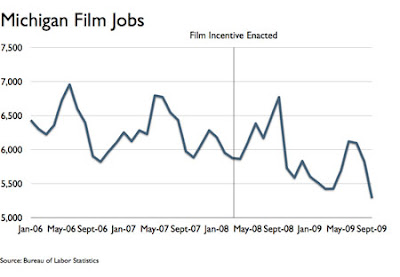
According to the most recent Bureau of Labor Statistics, as of September 2009 (the most recent month available*), there were fewer people employed by the film industry in Michigan than before the subsidy program began.
The film subsidy program was signed into law on April 7, 2008. In that month there were 5,867 jobs in Michigan's "motion picture and sound recording industries," the industrial classification that most closely fits the target industry for the program. By last September these jobs had fallen to 5,290, a 9.8 percent decline.
While the program's impact on the overall state economy is too small to measure, its effects on taxes and the budget are significant. The state has authorized $117 million in film credits, and the Department of Treasury estimates that the subsidies will cost $155 million in the upcoming fiscal year. This is equivalent to 7 percent of what the entire Michigan Business Tax currently extracts from businesses.

Monday, April 5, 2010
Government work pays 31% more in Michigan

Tuesday, March 30, 2010
Unions have snared 40,000 Michiganians through government shenanigans; is it a pilot program?
Gov. Jennifer Granholm's administration appears to be carrying out an audacious experiment in Michigan that could lead to the involuntary unionization of tens of millions of Americans.
At issue is a simple question: Can care givers be designated government employees simply because their customers receive public assistance?
The Granholm administration says yes. As a result, some 40,000 home day care providers have been enrolled in public employee unions, their dues subtracted from day care payments and paid directly by the state to the unions.
If the system survives court challenges, it seems likely that the Obama administration could apply it to other government programs, perhaps including Social Security, Medicare and Medicaid.
The pilot program, if that is what it is, would explain why President Barack Obama administration seems to be deliberately trying to extend government aid to more and more people. It also would account for Obama's determined effort to place SEIU lawyer Craig Becker, who holds radical views on union questions, on the National Labor Relations Board.
Democrat Gov. Granholm, officials of the state Department of Human Services, and a union front named Child Care Providers Together Michigan came up with a scheme to designate all home care providers who benefit from state assistance as state employees. Any provider whose clients receive assistance falls into that group.
The United Auto Workers and American Federation of State, County and Municipal Employees are on course to negotiate with the Michigan Home Based Child Care Council representing the providers.
Only 15 percent of the providers voted in the union certification election. Nevertheless, the unions were granted exclusive bargaining rights.
The state now deducts union dues from the checks it sends to the providers and forwards the money directly to the unions. That's about $3.7 million a year.
Imagine the windfall for the unions if that system was replicated in Washington for the millions who receive Social Security, Medicare, Medicaid, veterans benefits and other payments from government.
The free-market oriented Mackinac Center Legal Foundation, a public interest law firm, filed suit in the Michigan Court of Appeals arguing that Human Services illegally took money from day care providers to force them into a government employees union. The suit was dismissed, but has been refiled.
In February, the National Right to Work Legal Defense Foundation filed a class action against government union officials and the Granholm administration on grounds they illegally forced the providers to pay union dues. The suit argues that the union scheme violates the Constitution's gurantees of free political expression and association.
Last Saturday, the story took another interesting turn when President Obama placed Becker on the National Labor Relations Board through a recess appointment. The appointment had been filibustered by Republicans because of Becker's radical views.
Becker has argued that "employers should be stripped of any legally cognizable interest in their employees' election of representatives." Taken at face value, that means Becker favors universal unionization and more union control over small businesses.
In a 1993 Minnesota Law Review article, written when he was a UCLA professor, he explained that traditional notions of democracy should not apply in union elections. He wrote that employers should be barred from attending NLRB hearings about elections, and from challenging election results even amid evidence of union misconduct. He argues that elections should be removed from work sites and held on "neutral grounds," or via mail ballots. Employers should also be barred from "placing observers at the polls to challenge ballots," he maintains.
The Wall Street Journal writes, "More extraordinary, Mr. Becker advocated a new 'body of campaign rules' that would severely limit the ability of employers to argue against unionization. He argued that any meeting a company holds that involves a 'captive audience' ought to be grounds for overturning an election. If a company wants to distribute leaflets that oppose the union, for example, Mr. Becker said it must allow union access to its private property to do the same.
Mr. Becker isn't clear about which of these rules can be implemented by NLRB fiat, and which would require an act of Congress, but his mindset is clear enough. He's willing to push NLRB discretion as far as possible to tilt today's labor rules in favor of easier unionization."
Friday, February 5, 2010
Free Press: Want to see a preview of Obama's America? Look at the ruins of Granholm's Michigan
Detroit — Most Americans are just getting warmed up to the idea of a self-centered chief executive who has divined America’s future as a green economy and is brashly installing the industrial-policy tools to get us there. But we here in Michigan have been living it since Gov. Jennifer Granholm took office in 2003.
On Wednesday night, the flashy second-term governor celebrated the “change” she’s brought to Michigan in her final State of the State address. Read it and weep.
Granholm entered office on the tired heels of a three-term Republican with a wave of good tidings as the state’s first female governor. Beautiful, silver-tongued, and Harvard Law–educated, Granholm was a young pol with little executive seasoning. Supremely self-confident despite her inexperience, Granholm raised income taxes (as the state’s economy literally and figuratively headed south), “invested” billions of stimulus dollars in infrastructure that she predicted would create tens of thousands of jobs, mandated renewable-power standards, and backed them up with millions in government subsidies to transform Michigan from “the Rust Belt to the Green Belt.” In her 2006 State of the State address, she promised that “in five years, you’ll be blown away.”
Four years in and it’s blowing hard, all right. Michigan’s unemployment rate has more than doubled, to over 14 percent. Yes, the state’s per capita income drop from 20th in the nation to 40th has tracked a historic restructuring of the state’s auto industry, but Granholm’s Obamaesque policy prescriptions have been anti-growth while fueling budget deficits to record highs.
Thursday, January 21, 2010
Redecorating the living room as the house tumbles
Democratic demagoguery and hubris never fails to amaze. On the morning after the Massachusett's miracle or the revolt against out-of-touch lawmakers, we in Lansing, MI were greeted by two articles in the morning paper that help put the statist democrats into perspective: "Michigan to Furlough 17000 State Workers" and "First Gentlemen's Office Make-Over Just Routine."
While thousands of state workers, represented in Michigan of course by the UAW, will take 10 unpaid furlough days to help the state save money, the Governor's husand recently had his office remodeled. A concerned citizen emailed the paper:
"Thought you would be interested in the following: Dan Mulhern, the governor's husband, who has an office in the (Romney Building), paid for by Michigan taxpayers, is having his office remodeled. New carpet, paint ... all new everything!
"And just last weekend the state brought in workers, on overtime, to rip out all of the old (carpet) from his office ...
"What are they thinking when this state is in such a financial mess?"
An administration spokesperson confirmed the construction calling it "routine" and dismissing the whole matter by saying it cost less than $5,000. The state journal writer was provided an email response, that said in part:
"The First Gentleman does not have an office budget, per se. At this time he has one staff person, who is actually a member of the governor's executive office staff, who is assigned to assist Dan in the work he's doing on behalf of the administration."
Tuesday, November 24, 2009
SEIU's fingers reach into Michigan's Capital
Nestled between this week's state tax credits for auto suppliers, a furniture maker and a few high-tech companies is this gem: A $2 million credit to a for-profit affiliate of the Service Employees International Union to build a "Member Action Center."
The "shared organization" would "provide administrative services for the SEIU and other local labor organizations," says the Michigan Economic Development Corp. Despite cost disadvantages here over rival sites, the project would invest $3 million and create 224 new jobs -- in Redford Township.
That, by sheer coincidence, is the home of House Speaker Andy Dillon. He's the Democrat pushing a one-health-care-plan-for-all-state-employees that parts of the SEIU (among the most politically active unions in the nation right now) and other public-employee unions steadfastly oppose.
Which means the SEIU's new center and the hundreds of employees (theoretically) working there would become constituents of a speaker pushing the kind of reform that organized labor is working the Capitol to kill, not withstanding Michigan's "lost decade."
This was all done by the Michigan Economic Development Corp.'s Michigan Economic Growth Authority board -- which as Hewes notes, is composed almost entirely of gubernatorial appointees. Naturally, the Michigan Economic Development Corp. appears to be in bed with the SEIU:
Friday, October 16, 2009
Stimulus in Michigan cost $156,171 for each job
StimulusMichigan received $3.7 billion is stimulus money, of which $620 million was to be used to "create and save" jobs, while the remainder will be used by Granholm to backfill the budget deficit that she has created with her overspending so that she doesn't have to make any substantial cuts before she leaves office. When she walks away, she will have lost more than 1,000,000 jobs in a state with a population of only 10 million. A few days ago, Granholm claimed that stimulus money "created or saved" 19,500 jobs (Enron accounting: Stimulus saved or created 19,500 jobs in Michigan). Turns out, the number is an utter fabrication, as I suspected when I wrote that prior post. Fact is, that $620 million "created or saved" 397 jobs.
Let's just do the math. $620 million divided by say 400 jobs = $1,550,000 per job! That is an outright waste of taxpayer dollars. Worse yet, the rest of the $3.7 billion is going to keep Michigan in perpetual deficit that will be even more painful to deal with since we have had an AWOL governor for 6 1/2 years running. From The Detroit Free Press: So far, stimulus contracts aren't big boost for Michigan jobs.
Let's just do the math. $620 million divided by say 400 jobs = $1,550,000 per job! That is an outright waste of taxpayer dollars. Worse yet, the rest of the $3.7 billion is going to keep Michigan in perpetual deficit that will be even more painful to deal with since we have had an AWOL governor for 6 1/2 years running. From The Detroit Free Press: So far, stimulus contracts aren't big boost for Michigan jobs.
Friday, September 4, 2009
Michigan's drive for clean tech jobs mostly hot air
"A central belief in Washington and most state capitals nowadays is that government should "invest" in certain businesses—"clean tech," say, or manufacturing—to drive job creation. We hope it all turns out better than it has in Michigan.
For the past 14 years, Lansing politicians have offered $3.3 billion in tax credits through the Michigan Economic Development Corporation and spent another $1.6 billion in outlays to create and retain jobs. The subsidies have ranged from tax breaks for Hollywood, to money for new industrial plants, to millions for TV ads starring Jeff Daniels and Tim Allen talking about business and tourism in the state.
It's one of the largest experiments in smokestack chasing in American history, but one thing it hasn't done is create jobs. An exhaustive new 100-page study by the Mackinac Center for Public Policy, a Michigan think tank, has reviewed where all the money has gone and what came of it. The study finds that for every 100 jobs that were promised with these tax credits over 14 years, only 29 arrived. Dare we call this cash for clunkers?"
Wednesday, August 12, 2009
Sea Monsters in Lake Michigan? And people still wonder why Michigan is a failed state?.
"Michigan just experienced its coldest July on record; global temperatures haven't risen in more than a decade; Great Lakes water levels have resumed their 30-year cyclical rise (contrary to a decade of media scare stories that they were drying up due to global warming), and polls show that climate change doesn't even make a list of Michigan voters' top-ten concerns.
Yet in an interview with the Detroit News Monday, Senator Debbie Stabenow (D., Mich.) - recently appointed to the Senate Energy Committee - made clear that fighting the climate crisis is her top priority.
"Climate change is very real," she confessed as she embraced cap and trade's massive tax increase on Michigan industry - at the same time claiming, against all the evidence, that it would not lead to an increase in manufacturing costs or energy prices. "Global warming creates volatility. I feel it when I'm flying. The storms are more volatile. We are paying the price in more hurricanes and tornadoes."
And there are sea monsters in Lake Michigan. I can feel them when I'm boating."
Subscribe to:
Posts (Atom)