Has Congress become "a useless appendix on the governmental structure"? That was what then-Senate Foreign Relations Committee Chairman Sen. J. William Fulbright, D-Ark., feared in 1968, according to newly released transcripts from the committee's closed-session debates over Vietnam. Unless Congress was willing to assert itself on the war, he said, "I do not see how we have any real function."
Last week found Congress once again doing a good imitation of a vestigial organ, as the House forked over $37 billion more for our endless Afghan adventure. Maybe if we called it "armed community organizing" instead of "nation building," more Republicans would be against it.
It's "not just the president's war," Rep. Jim McGovern, D-Mass., protested. "It's our war too. ... We must not simply kick the can down the road."
Alas, legislative can kicking is what the modern Congress does best. Take the Dodd-Frank financial "reform" bill the president just signed. It's a 2,300-page PR exercise that delegates everything and settles nothing. Lenders and investors wondering what's legal will have to await some 243 rulemakings from 11 different agencies.
Congress ducks responsibility because We the People have let them get away with it for far too long.
The Constitution gives Congress vast powers over war and peace, and charges it with making the laws of the land. Yet our feckless legislators prefer to punt the hard decisions to the president and the permanent bureaucracy, even if it leaves the rest of us mired in uncertainty and crushing debt. What do we pay these people for?
There's a reason the Capitol Dome dominates the D.C. landscape, towering over the comparatively modest presidential residence down the street. The capital's design mirrors the constitutional architecture, in which Congress, not the executive, was supposed to be the prime mover in setting national policy.
The legislative branch "is by far the most important," President James Monroe proclaimed in 1822, "the whole system of the National Government may be said to rest on the powers granted to this branch. They mark the limit within which, with few exceptions, all the branches must move."
Some of you understandably shudder at the thought of handing more responsibility to an institution led by the likes of Nancy Pelosi. But our Constitution's Framers preferred to leave national policy in the hands of bums you can vote out instead of bums you can't, like the best and brightest White House czars and unelected bureaucrats.
Despite decades of congressional abdication, Congress retains every power the Constitution grants it. There's nothing stopping legislators from drafting clear rules or taking responsibility for ongoing wars.
Even John Yoo, the Imperial Presidency's most ardent fanboy, admits that Congress could legally "require scheduled troop withdrawals" in foreign wars.
Showing posts with label Congress. Show all posts
Showing posts with label Congress. Show all posts
Sunday, August 8, 2010


Why didn't financials overhaul include Fannie & Freddie? They hire out-of-work Democrats and finance Dem campaigns
WHILE Congress toiled on the financial overhaul last spring, precious little was said about Fannie Mae and Freddie Mac, the mortgage finance companies that collapsed spectacularly two years ago.
Indeed, these wards of the state got just two mentions in the 1,500-page law known as Dodd-Frank: first, when it ordered the Treasury to produce a study on ending the taxpayer-owned status of the companies and, second, in a “sense of the Congress” passage stating that efforts to improve the nation’s mortgage credit system “would be incomplete without enactment of meaningful structural reforms” of Fannie and Freddie.
No kidding.
With midterm elections near, though, there will be talk aplenty about dealing with the companies precisely because Dodd-Frank didn’t address them. Unfortunately, if past is prologue, this talk is likely to be more political than practical.
Fannie and Freddie amplified the housing boom by buying mortgages from lenders, allowing them to originate even more loans. They grew into behemoths because they lobbied aggressively and played the Washington political game to a T. But after both companies bought boatloads of risky mortgages, they required a federal rescue.
Friday, August 6, 2010
Soft bribery of politicians takes another form: endowments
WASHINGTON — Nearly a dozen current or former lawmakers have been honored by university endowments financed in part by corporations with business before Congress, posing some potential conflicts like that attributed to Representative Charles B. Rangel in an House ethics complaint.
The donations from businesses to the endowments ranged from modest amounts to millions of dollars, federal records show. And the lawmakers, who include powerful committee chairmen or party leaders, often pushed legislation or special appropriations sought by the corporations.
An endowed chair at the University of Hawaii honoring Senator Daniel K. Inouye, the Hawaii Democrat and chairman of the Senate Appropriations Committee, was financed in part by $100,000 from a cruise ship line that the senator helped with legislation allowing it to expand its American ports of call.
A program at South Carolina State University named for Representative James E. Clyburn, the third-ranking House Democrat and a key backer of legislation to promote new nuclear power plants, stands to benefit from donations by Fluor and Duke Energy, which want to build plants.
And an endowment at the University of Louisville intended as a tribute to Senator Mitch McConnell of Kentucky, the Republican minority leader, has received hundreds of thousands of dollars from a military contractor that later got a $12 million earmark sponsored by the senator.
Companies and lawmakers defend the donations as simply contributions to a good cause, but critics charge that they are a way for businesses to influence lawmakers in addition to campaign contributions, and without the limits or required disclosures.
“It is another way to curry favor — and a less visible one,” said Melanie Sloan, executive director of Citizens for Responsibility and Ethics in Washington. “But it can perhaps be even more effective, because the sums can be much vaster, and it really feeds the members’ vanity as these centers are something that will last in perpetuity.”
Monday, August 2, 2010
Obama relying on lame ducks to increase taxes after election
The CBO this month provided some more bad news for Americans and good news for those pushing tax hikes. It released a report indicating the federal government took in $1.6 trillion and spent $2.6 trillion in just the first nine months of the fiscal year. That’s a deficit of $1 trillion in a mere nine months. Do you now understand why President Obama is pushing for a special session of Congress—after the elections—to raise taxes?
Obama was smart in the way he set up his commission. It reports to Congress on December 1. Congressmen who were voted out of office in November for excessive government spending will be allowed to stick it to the taxpayers one more time by voting for massive tax increases, and, since they’re already unemployed, they’ll face no electoral consequences.
The President told his commission that “everything has to be on the table.” Translated, this means the commission needs to marry small, symbolic spending cuts with higher taxes on the average American. In testimony before the commission, the Committee for a Responsible Federal Budget suggested a carbon tax to raise money. Others want a value-added tax. A VAT is essentially a hidden national sales tax that could raise the federal tax bite by 25% or more. Both of these proposals would hit lower-income people who are looking for jobs. Taxpayers should worry that lame-duck politicians, lacking all accountability, will make one last effort for team Obama and raise taxes.
Wednesday, July 28, 2010
Congress racing blindfolded, heaving huge fraudulent bills
A Gallup poll reveals that only 11 percent of Americans have a great deal of confidence in Congress, and though it's the lowest ranking ever, one wonders what malady afflicts the yea-sayers. Might a review of reality correct their misperceptions?
To do the task justice would require at least as many pages as some of the bills Congress passes, but that itself is a place to start -- mention of a debt-stimulating stimulus bill over 1,000 pages long, of a topsy-turvy health-care remake over 2,000 pages long and of a recent financial-regulation mishmash also over 2,000 pages long.
Members of Congress maybe have some study-guide notion of what's in these bills, but no grasp of all the possible catastrophes hidden in multiple unread clauses. Passing them is therefore akin to the blindfolded racing of a bus down a busy highway. The public -- the passengers -- knows even less, of course, and has to guess at what might happen to it.
At least some of the devilish details do emerge in time, and so you learn that even if an $862 billion stimulus was defensible in theory, the political handouts got out of hand, virtually ensuring any assault on the recession would be feathery at best.
The health bill, it turns out after inspection by various nonpartisan groups since its enactment, was pretty much a fraud from beginning to end. It's going to control health costs? Just the opposite, and here is more bad news -- this fiercely expensive entitlement comes on top of old entitlements -- Social Security, Medicare and Medicaid -- that already threaten to help create fiscal chaos and uncontrollable debt in not so many more years.
Our economy is hugely at risk, and Congress did this to us.
Tuesday, July 20, 2010
Gunny Pop running against liberal San Diego Rep. Bob Filner

By James M. Simpson
A few months back I wrote a story about Veterans for Congress, focusing in particular on Marine Gunnery Sgt. Nick Popaditch, who is running for Congress in San Diego’s 51st district. “Gunny Pop” as he was affectionately known in the Corps, was grievously wounded in the first battle for Fallujah, Iraq, when he was hit in the head by an enemy RPG. Medically retired, he lost one eye and retains 8 percent use in his second eye, only because of the medical staff’s heroic efforts and Nick’s indomitable spirit.
A few months back I wrote a story about Veterans for Congress, focusing in particular on Marine Gunnery Sgt. Nick Popaditch, who is running for Congress in San Diego’s 51st district. “Gunny Pop” as he was affectionately known in the Corps, was grievously wounded in the first battle for Fallujah, Iraq, when he was hit in the head by an enemy RPG. Medically retired, he lost one eye and retains 8 percent use in his second eye, only because of the medical staff’s heroic efforts and Nick’s indomitable spirit.
Nick earned the Silver Star for his battlefield bravery and innovation. Nick is also widely recognized as the Cigar Marine, who sat atop his M-1 Abrahams tank triumphantly smoking a cigar while members of his unit helped topple Saddam’s statute when the Marines liberated Baghdad in 2003. He wrote a book about his experiences, Once A Marine, which made the Commandant of the Marine Corps recommended professional reading list for all ranks, won The Military-Writers Book of the Year for 2009, and was a national book club selection.
Contrast this with his Democrat opponent, Bob Filner. One of the most radical leftists in the House of Representatives, Filner is spawn of Joe Filner, one time head of the Pittsburg, PA, Communist Party. (NOTE: thanks go to Trevor Loudon for the Filner profiles, among thousands of entries Loudon has put together for his seminal encyclopedia of the Left, KeyWiki. Check it out!)
The nuts don’t fall far from the tree. A longtime member of the Congressional Progressive Caucus, Filner has close ties the Democratic Socialists of America. He has been staining the halls of Congress since 1992, and has been foursquare behind the Obama deliberate trainwreck agenda since his fellow socialist was elected President.
Friday, July 16, 2010
He's not on the ballot, but 41% will vote against Obama's policies
Voters will go to the polls this November with control of Congress at stake. Yet most voters say when they pull that lever, they will be sending a message to the White House, according to a Fox News poll.
The poll, released Friday, finds that 41 percent of voters will cast their ballots to register opposition to President Obama's policies. A third (33 percent) will vote to express their support. The policies of the administration will not be a factor for 20 percent of voters.
Most Republicans — 72 percent — describe their midterm vote as expressing opposition to the Obama administration. That's a bit higher than the 64 percent of Democrats who say their vote will express support. One in 10 Democrats will vote to express opposition to the president (11 percent).
Independents are nearly 20 percentage points more likely to say their vote will express opposition (41 percent) rather than support (23 percent) for Obama policies. Thirty-three percent of independents say the administration won't influence their vote.
If the election were held today, 41 percent of voters would back the Republican candidate in their congressional district and 37 percent would vote for the Democratic candidate. That's little changed from two weeks ago when the vote favored the Republican candidate by 42-40 percent (June 29-30).
Saturday, July 10, 2010
When NASA downgrades space exploration, Al Jazeera gets tip
Lawmakers across Capitol Hill, both Democrats and Republicans, were surprised to learn recently that the Obama administration has made reaching out to Muslim nations a top priority for the space agency NASA. They will probably be more surprised to learn that administration officials told the Middle East news organization Al Jazeera about it before they told Congress.
Rep. Pete Olson, the ranking Republican on the House Subcommittee on Space and Aeronautics, got a call from NASA Administrator Charles Bolden on June 28, the day the White House released its new long-term plan for the space program. "He ran down some of the things from the president's new space policy, and mentioned outreach to Muslims," Olson recalls. "That stunned me. I didn't believe it."
Rep. Gabrielle Giffords, the Democrat who chairs the subcommittee (and is also married to astronaut Mark Kelly), got a briefing from Bolden the same day, according to a spokesman.
As it happens, Bolden's calls to Giffords and Olson came several days after Bolden discussed the Muslim initiative with Al Jazeera. According to a NASA spokesman, Bolden sat down with Al Jazeera's Imran Garda on June 17, during a stop in Doha, Qatar. Bolden's Mideast trip, which was timed to mark the first anniversary of President Obama's June 2009 Muslim outreach speech, was devoted to pursuing "a new beginning of the relationship between the United States and the Muslim world."
During the interview, Bolden told Al Jazeera that the "foremost" mission he had been given by Obama was "to find a way to reach out to the Muslim world and engage much more with dominantly Muslim nations to help them feel good about their historic contribution to science, math, and engineering."
The Al Jazeera interview did not air until June 30, after the Obama space plan was released and Bolden briefed members of Congress. But there's no question Al Jazeera got the word first.
Monday, May 24, 2010
Rasmussen: 63% favor repeal of Obamacare
The Rasmussen Reports daily Presidential Tracking Poll for Monday shows that 25% of the nation's voters Strongly Approve of the way that Barack Obama is performing his role as president. Forty-three percent (43%) Strongly Disapprove, giving Obama a Presidential Approval Index rating of -18 (see trends).
Following passage of health care, enthusiasm for the president among Democrats soared. Today, however, just 49% of Democrats Strongly Approve of Obama’s performance. That’s down from a high of 65%. It remains to be seen whether this is a temporary aberration or the beginning of a lasting change.
Sixty-three percent (63%) of voters nationwide favor repeal of the health care law. That’s the highest level of support for repeal yet measured.
The Presidential Approval Index is calculated by subtracting the number who Strongly Disapprove from the number who Strongly Approve. It is updated daily at 9:30 a.m. Eastern (sign up for free daily e-mail update). Updates are also available on Twitter and Facebook.
Overall, 44% of voters say they at least somewhat approve of the president's performance. Fifty-four percent (55%) disapprove. The Rasmussen Reports Media Meter shows that media coverage of the President has been 51% positive over the past week.
Just 27% are even somewhat confident that Congress knows what it’s doing when addressing that nation’s economic challenges. That figure includes only 6% who are Very Confident that Congress knows what it’s doing.
Friday, May 21, 2010
Congressional Democrats applaud Mexican President Felipe Calderon after he endorses practices that damage the U.S.
If you are winning, go with the status quo.
That's what Mexican president Felip Calderon did this week. The question is, why did congressional Democrats give Calderon a standing ovation? Was that because the U.S. is losing, and further decline will hasten the day when free enterprise and free markets, institutions that many of the Democrats deplore, are finally tossed aside in favor of government by the biggest donors to their campaigns?
The most important relationship between Mexico and the United States is economic.
Mexico exports poverty and low skills to the United States.
The United States, in turn, supplies education and welfare benefits to imported Mexicans who, in turn, export billions of dollars to Mexico. In 2007, those remittances totaled $23.98 billion. In 2008, the total rose to $25.145 billion.
While the figure for 2009 is not yet in, it is expected to fall to about $21 billion. Hard times are at hand in Mexico.
If Arizona's new immigration law deters illegal border crossings into Arizona, the number of illegal aliens sending remittances to Mexico might fall off on a lasting basis. Emulation of the Arizona law by other border states could put a real crimp in Mexico's profit from illegal border crossings.
That's why Calderon spoke with such urgency about the awfulness of the Arizona law. President Obama appeared to agree with him, which was not surprising for a chief executive who has little good to say, but much to rebuke, about the land he has chosen to misgovern while awaiting his chance to govern the world.
Wednesday, April 14, 2010
Dem leader: Tea Party stirs retirement thoughts
House Majority Leader Steny Hoyer, D-Md., told reporters today that the Tea Party movement is making some members of Congress mull retirement.
“Do I think the negative atmosphere that has been created by the Tea Party and by others certainly goes into the thinking of members? I think it does. I think you have to honestly point out that it does,” he told reporters Tuesday.
Hoyer was responding to questions about Michigan Rep. Bart Stupak’s decision last week to retire rather than seek another term. Stupak had led a group of pro-life Democrats who opposed the health care bill through much of the debate, arguing that its anti-abortion provisions were too weak.
Under heavy pressure from the White House and party leaders, Stupak struck a last-minute deal that secured enough votes for the bill to pass the House. His actions ended up ticking off both liberal and conservative groups.
Friday, April 9, 2010
After too much (tea) partying, Stupak retires
Rep. Bart Stupak (D-Mich.), who had a central role in the health reform fight as the leader of anti-abortion Democrats, plans to announce Friday that he will not run for reelection, a Democratic official said. Without Stupak on the ballot, the seat becomes an immediate pickup opportunity for Republicans.
"Now with health care done, he’s retiring," a friend said. "He has thought about retiring for the last three cycles, but was always talked into staying: to elect John Kerry to help end the war, to elect a Democratic majority to get health care done."
President Barack Obama called Stupak on Wednesday and asked him not to retire. Stupak, 58, also resisted entreaties from Speaker Nancy Pelosi and Rep. John Dingell (D-Mich.), the dean of the Wolverine State delegation.
Republicans immediately attributed Stupak's decision to step down as a direct consequence of his health care vote.
“After selling his soul to Nancy Pelosi, it appears that Bart Stupak finally found the courage to tell her no," said National Republican Congressional Committee communications director Ken Spain. "The political fallout over the Democrats’ government takeover of healthcare has put the political careers of many Democrats in jeopardy thanks in-part to Stupak’s decision to abandon his alleged pro-life principles."
From the Petoskey News Review:
...Stupak has become a symbol for critics of the overhaul. The Tea Party Express labeled him its No. 2 target for defeat after Senate Majority Leader Harry Reid of Nevada.
The group kicked off a $250,000 television and radio blitz in Stupak’s district Wednesday, ahead of rallies that began Thursday night and were continuing through the weekend.
“Bart Stupak has lost touch with the people of Michigan, and he has betrayed the public’s trust,” said Mark Williams, the group’s chairman.
Three little-known hopefuls are seeking the GOP nomination, and Stupak faced a primary challenge from a Democrat who is pro-choice on abortion.
Even so, Michigan’s 1st District is notoriously difficult turf for anyone trying to unseat the incumbent. Measuring 600 miles across, it takes in about half the state’s land mass — including the entire Upper Peninsula — and has no major media market. The largest city, Marquette, where Stupak was planning to officially announce his retirement later Friday, has about 20,000 residents.
Stupak has routinely won re-election by wide margins, defeating former state Rep. Tom Casperson with 65 percent of the vote in 2008, and said he was confident of prevailing again.
He acknowledged the criticism he received over the health care reform — including telephone threats to his office — had taken a toll, but said he had thrived during the debate. What wore him down, he said, was the grind of constant travel across his sprawling district.
Saturday, March 27, 2010
Michigan Right to Life rescinds Stupak endorsement, endorses his Republican opponent
Michigan Right to Life has always endorsed Congressman Bart Stupak (D-MI) and was backing him for re-election this year. But after his pivotal vote for health care reform without the inclusion of legally binding language banning taxpayer funding of abortion, the group has rescinded its endorsement and pledged to support his Republican challenger, Dan Benishek.
Stupak, until Sunday one of Congress' most reliable pro-life legislators, was notified of this decision on Wednesday. The Right to Life of Michigan PAC's board of directors voted unanimously to switch sides in the race after Stupak's decisive shift.
Stupak, until Sunday one of Congress' most reliable pro-life legislators, was notified of this decision on Wednesday. The Right to Life of Michigan PAC's board of directors voted unanimously to switch sides in the race after Stupak's decisive shift.
Wednesday, March 24, 2010
Is the scene set for a replay of Clinton and the 90s?
The undertakers of Bill Clinton's political doom showed up in Little Rock, Ark., in 1992 for a meeting with the president-elect two months before his inauguration. They were the leaders of the Democratic Congress, and they might as well have been draped in black crepe.
"You can trust us," House Speaker Tom Foley told Clinton, in an assurance as false as it was sincere. "We all want to make this administration succeed."
Two years later, Clinton stood among smoldering political ruins. Democrats had lost both houses of Congress. A Republican upstart had defeated Tom Foley. In trusting the Democratic leadership in Congress, Clinton had nearly destroyed his presidency.
He learned a bitter lesson in the perils of trying to govern a center-right country in league with a left-wing Congress. It's not an accident that the most sustained period of political success for any of the last three Democratic presidents, outside of their initial honeymoons, came after Clinton lost Congress. Only then was he forced to govern from the center.
Pew: Congress said to be dysfunctional, corrupt and selfish, but also incompetent, lazy and bad
Late on Sunday, March 22, the House of Representatives voted to approve a far-reaching overhaul of the nation's health care system. President Barack Obama is expected to sign the bill into law promptly, as well as fixes to the legislation also passed by the House if those changes are approved by the Senate.
Shortly before the House vote, the Pew Research Center asked Americans to provide the one word that best describes their current impressions of Congress. The results were overwhelmingly negative. Of those offering a response, 86% said something negative while just 4% gave a positive one-word description. The three most frequently offered terms were dysfunctional (21 people offered this), corrupt (20) and some version of selfish (19). Many of the words reflected perceptions that Congress has been unable or unwilling to enact legislation (inept, confusing, gridlock, etc.).
Please note that the figures shown in the chart represent the actual number -- not the percentage -- of people offering each word. With such a wide range of terms volunteered, no single word was offered by more than 3% of the 749 people asked the question.
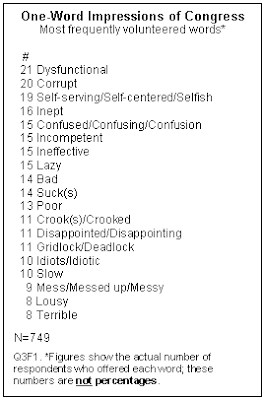
Shortly before the House vote, the Pew Research Center asked Americans to provide the one word that best describes their current impressions of Congress. The results were overwhelmingly negative. Of those offering a response, 86% said something negative while just 4% gave a positive one-word description. The three most frequently offered terms were dysfunctional (21 people offered this), corrupt (20) and some version of selfish (19). Many of the words reflected perceptions that Congress has been unable or unwilling to enact legislation (inept, confusing, gridlock, etc.).
Please note that the figures shown in the chart represent the actual number -- not the percentage -- of people offering each word. With such a wide range of terms volunteered, no single word was offered by more than 3% of the 749 people asked the question.

Friday, March 19, 2010
Dozens of doctors running against congressional Democrats; let the radical colostomies begin
For some of the brightest, most politically aware people in the country, the yearlong debate over the Democrats' national health care plan has been an inspiring experience. It has inspired them to run for Congress as Republicans.
Dr. Larry Bucshon is one of them. A heart surgeon in Evansville, Ind., Bucshon watched the first months of Barack Obama's presidency with growing alarm. "It became clear to me that what he said in the campaign -- big government, more spending, more federal government control -- was what he was really going to do," says Bucshon. By last summer, as the president and congressional Democrats turned to health care, Bucshon was thinking about running for the House from Indiana's 8th District. By October, he was in the race.
Bucshon is just one of what House GOP leaders believe is the best class of new candidates in many years. "So far, our successful recruitment efforts have helped produce over 95 top GOP recruits," says Rep. Kevin McCarthy, who is leading the recruitment drive for the National Republican Congressional Committee. And those are just the hot prospects in potentially winnable districts; there will also be Republican challengers for even the safest Democratic seats.
Talk to the new candidates, and they're worried about the entire scope of Obama policy. But an indicator of the specific effect of Obamacare is the unusually large number of new recruits -- 31 -- who come from the medical profession. Twenty-four are doctors. The GOP already has a significant advantage in the number of physicians-turned-lawmakers -- at the Obama health care summit, the Republicans brought three doctors to the table, while the Democrats brought none -- and that advantage will probably be larger in 2011.
That gives them a special authority on what will surely be a continuing debate over Obamacare. "I think it will basically decimate the health care system in America," says Bucshon. "The number of doctors who are going to retire, and the number of young people who are no longer going to go into medicine, will be massive."
Wednesday, March 17, 2010
Pollster Peter Hart: "The memo is pretty simple - ‘Americans to Congress: You stink’"
Only 17 percent of American voters approve of how lawmakers on Capitol Hill are doing their jobs and, given the choice, half of all respondents in an NBC poll would vote to defeat their own representative and every single member of Congress.
It's a striking finding revealing that a majority of Democrats are sour on their party even as it controls all three branches of government. The public also is sour on the nation’s direction. Nearly 6 in 10 believe the country is off on the wrong track, compared with 33 percent who think it’s headed in the right direction.
And a combined 88 percent say they’ve been personally affected by the downturn in the economy "a great deal," "quite a bit" or "just some."
"The memo is pretty simple — ‘Americans to Congress: You stink,’" says Democratic pollster Peter D. Hart, who conducted the survey with Republican pollster Bill McInturff.
"To me, this is an exceptionally important story."
Friday, March 5, 2010
Throw the bums out sentiment is expanding
Congress, it turns out, isn’t the only institution held in low esteem by voters this year.
According to a POLITICO review of publicly available polling data, numerous state legislatures are also bottoming out, showing off-the-charts disapproval ratings accompanied by stunning levels of voter cynicism.
It all adds up to a toxic election-year brew for legislators inside and outside Washington.
The freshest example comes from Pennsylvania, where a Quinnipiac University poll released Wednesday surveyed the attitudes of residents and reported that just 29 percent of Pennsylvania voters said they approved of the job the state legislature is doing in Harrisburg, a slippage of 13 points since last May.
Friday, February 26, 2010
London's Times does the job U.S. mainstreamers refuse to do - make fun of poseur Barack Obama
Warning: watching American politicians argue about healthcare can be seriously damaging to your health. Symptoms may include migraines, extreme fatigue and sudden violent urges. In the event of exposure to competing statistics — regarding "donut holes", "HMO deductibles", "reconciliation devices" or suchlike — seek immediate medical help.
The public affairs television channel C-Span 3 might as well have put such a message at the bottom of its screen yesterday as it broadcast President Obama’s epic six-hour "bipartisan" debate on US medical reform.
Of course, by the usual standards of C-Span programming — which can induce sleep faster than an IV drip of propofol — the summit was the equivalent of a bikini mud wrestling contest. You half expected the picture to shake as the camera operator struggled to compose himself.
For the rest of us, however, it was mainly an opportunity to see how many conciliatory-looking poses Obama could strike while listening to his Republican opponents explain why the entire first year of his administration has been a gigantic waste of time, and why the telephone directory-sized health Bills produced by both the Democrat-controlled House and Senate should be fed into a shredder the size of Connecticut, before they . . . well, no one seems to know exactly what these vast pieces of legislation would do.
Except that it won’t be good, because the US Congress generally only does expensive and complicated.
Wednesday, February 24, 2010
Americans united in belief "that politicians are corrupt" and neither party has the answers
Voter unhappiness with Congress has reached the highest level ever recorded by Rasmussen Reports as 71% now say the legislature is doing a poor job.
That’s up ten points from the previous high of 61% reached a month ago.
Only 10% of voters say Congress is doing a good or excellent job.
Nearly half of Democratic voters (48%) now give Congress a poor rating, up 17 points since January. The vast majority of Republicans and voters not affiliated with either party also give Congress poor ratings.
Seventy percent (70%) of voters say Congress has not passed any legislation that would significantly improve life for Americans, up 10 points over the past month and the highest level of dissatisfaction measured in regular tracking in over three years. Only 15% say Congress has passed such legislation.
Forty percent (40%) of voters nationwide now say it is at least somewhat likely Congress will seriously address the most important issues facing the nation. That’s down from 59% last March. Only 9% say it is Very Likely Congress will address these issues.
These numbers are consistent with the analysis provided in Scott Rasmussen’s new book, In Search of Self-Governance. Scott notes that “Today, Americans are united. United in the belief that our political system is broken, that politicians are corrupt, and that neither major political party has the answers.” He adds, “Some of us are ready to give up; some of us are ready to scream a little louder. But all of us believe we can do better.”
Subscribe to:
Posts (Atom)